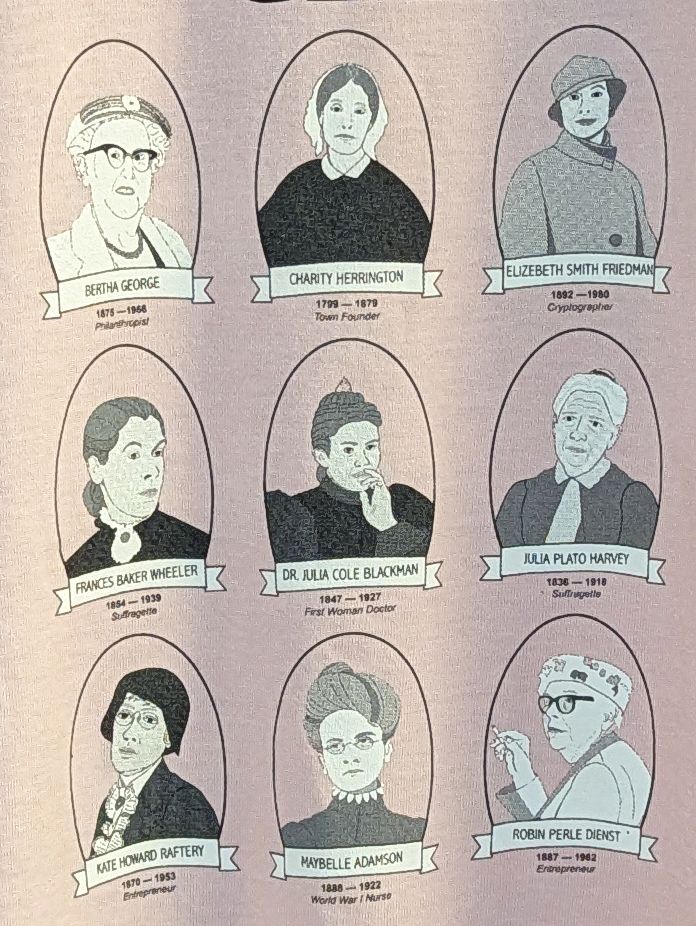
In honor of Women’s History Month, the museum created a t-shirt featuring nine women who made an impact on our town. There are too many legends to include on one t-shirt so we may create a new version each year. Here are the highlights of the nine women featured this year.
Why do you support the Geneva History Museum? I have a keen interest in American history and I was raised in Geneva. My involvement with the museum started after I attended a program about the State Girls School. A friend in high school dated the assistant superintendent’s daughter. When we double-dated, I would get cleared to go inside the property. So, I was familiar with the school, but I learned so much about the history behind it. By volunteering at the museum, I get to look at and research old photos and slides and read old newspapers, some as far back as the 1850. I learn something new about Geneva’s history each day, and that’s exciting. What is one of your favorite Geneva stories? Both of my favorite stories about living in Geneva are weather related. A tornado swept through the east side of Geneva destroying a few homes in the Ridgewood and Fieldbrook subdivisions where my brother and I had a paper route. In order to do the route after the tornado went through, we had to go through a police checkpoint. Being two curious 12 year-olds, we wanted to see the damage. I purposely missed a few houses so my brother could go see the damage too. The other story is about the blizzard of 1967. No one could drive a car for quite a while because the plows were busy clearing the main streets. So my dad, brother and I took our sled and hiked to Frank’s food store at the corner of East Side Drive and State Street. When we got to the store, there was barely any food left on the shelves but, we got what we needed and took the long hike back home. We also climbed a snow drift to the roof of our house and jumped off into another drift. What fun! Share a fun experience you have had with GHM. One of the most fun experiences I’ve had at the museum, and one of the hardest, was when the staff and several volunteers moved the entire collection from the basement of the museum to the ground floor so we could install a new shelving system. To complicate things further, we did this during the Covid pandemic. Every time we came to the museum, we had to have our temperature taken, sign in, mask up and put on latex gloves. I worked on moving the acid-free boxes in the basement to the first-floor gallery. The main concern was keeping them in numerical order to make it easier to put them back. We moved the boxes and then the old shelves. The shelves were a little unsteady because we couldn’t bolt them to the floor. So, we figured we could just wire them together and that would be enough support. Boy were we wrong. One of the shelves started wobbling and that started the chain reaction. Suddenly, the majority of the boxes hit the floor and made quite a mess. Luckily, the boxes stayed intact when they hit the floor and we were able to quickly clean up.
Starting in September 2024, the Geneva History Museum will offer monthly programs “2nd Tuesdays @ 2 PM” in place of the former Brown Bag Programs. The format of the programs will remain the same, with a 45-minute presentation on a different topic each month, just the time of day has changed to 2 PM instead of noon. The monthly programs will be offered from September thru May, with no programs in December or January. Registration is important for the museum to set up the room and to make sure all guests have a place to sit. Admission is $5/person, and free for museum members (just one of the many benefits of membership). Check our website for upcoming programs , or call 630-232-4951.
Ethical codes evolve in response to changing conditions, values and ideas. A professional code of ethics must, therefore, be periodically updated. It must also rest upon widely shared values. Although the operating environment of museums grows more complex each year, the root value for museums, the tie that connects all of us together despite our diversity, is the commitment to serving people, both present and future generations. The Geneva History Museum Board of Directors reviews policies regularly and recently revised its Institutional Code of Ethics, one of the core documents of the American Alliance of Museum’s national accreditation. It includes accountability, conflict of interest, duty to disclose, management, historical resources, access, and interpretation which apply to all staff, volunteers and anyone who works on behalf of GHM. GHM Institutional Code of Ethics (revised and approved by the GHM Board of Directors, February 27, 2024) The Geneva History Museum (GHM) is an independent nonprofit organization operated by the Geneva Historical Society. GHM takes seriously its responsibilities to preserve and make available to the public the documentary, artifactual, artistic, scientific and architectural resources of the city, and to promote and support the stewardship of such resources held by others. GHM is committed to making its resources widely accessible to the public, balanced with the need to preserve those resources for future generations. GHM is headed by a Board of Directors voted into office by the general membership or the Board of Directors. Their primary responsibilities are to protect and promote GHM, as well as the human, physical and financial resources made available for that purpose. GHM has a professional, paid staff assisted by volunteers. This Code of Ethics applies to all who work for or on the behalf of GHM. Accountability
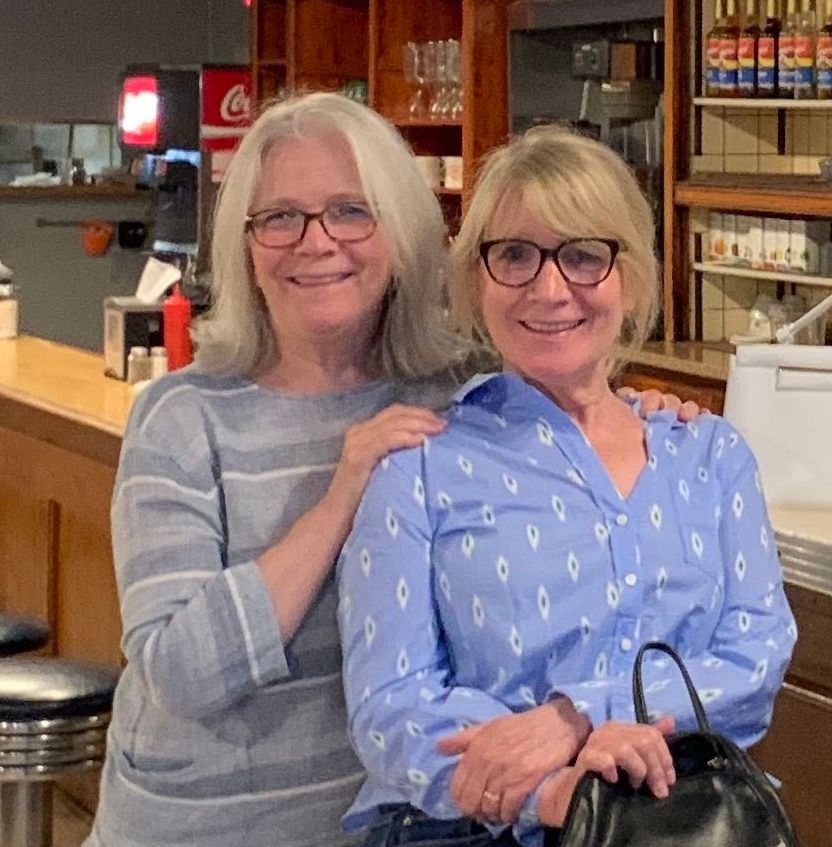
Nancy Bell & Pat Kessler “Never were there such devoted sisters…” Sisters, Nancy Bell and Pat Kessler grew up in Geneva. They volunteer weekly at the museum and are G.E.M.s – Giving Every Month. Nancy is a former board member and helps in the archives. Pat assists with the inventory of the collection. Why do you support the Geneva History Museum? NANCY: I have always been interested in history, especially local history. Knowing the story of where I live or visit allows me to connect to a place in a meaningful way. We lived for several years in a small Massachusetts town. Here I realized you don’t have to grow up in a community to relate to its history. Getting involved is key to understanding and preserving the story. Having roots is a bonus, not a necessity. Returning to Geneva in the 1980’s I was eager to reconnect with my family history through what is now the GHM. I had two terms on the Board, spanning from Wheeler Park to Third Street. My job at the Geneva Library allowed me to collaborate on youth programs with the Museum and as a retiree I volunteer in the archives. GHM is a vibrant institution. Geneva’s story stays updated with rotating exhibits. A permanent gallery offers a glimpse into the past through audio-visual as well as historic objects. The Story booth allows all to record their memories and become part of history. I am proud to be a part of the Geneva History Museum. As a volunteer and Herrington Circle member, I am investing in preserving Geneva’s story. PAT: Geneva History Museum is important to me because preserving history helps us remember who and how we have such a beautiful place to live. I love that we have the pieces of history that remind us of how hard some worked, or how creative some were, or how generously some gave…. And now that the museum is even more technology oriented, it opens it up to anyone who has a story to tell. (like my seven year old granddaughter!) It amazes me to see the items not only saved, but then donated to the museum to authenticate a family’s story! Geneva has such a fascinating history and when the museum highlights those bits with its displays and programs, you realize how much would have been lost if not for the hard work and dedication of today’s staff and volunteers, but also all those people who saw the need and value way back when. What is one of your favorite Geneva stories? NANCY: My favorite Geneva story is about our North First Street neighborhood. The 1950s and early 60s was an ideal time to be a kid. We considered our “hood” to be the area between Peyton and Ford Streets, N. First and N. Second. We claimed both sides of the streets. The anchor was made up of three main families, with a combined total of eighteen kids. We Hoelschers had seven, Epperlys seven and Haroldsons four.The majority were baby boomers. Several other families moved in and out over the years but we three remained the longest. Luckily most of the kids lived on N. First, leaving the rest of the block pretty much kid free. North First was our realm, “The Pit” as we called Wheeler Park, was our first frontier. Just two blocks away, we could get there in minutes. A converted gravel quarry, Wheeler was still evolving into the beautiful park it is today. The perimeter remained untamed, featuring jagged edges and steep slopes on the South and West. “Our” end, the dead end at N. 2nd Street, was the most dangerous. Precarious ridges between abandoned excavated pits were worn smooth from hundreds of local kids tramping over the narrow paths on foot or bikes. Riding bicycles up and down the craters was a death-defying act. We’d all watch a brave soul with admiration as they navigated around the rock, debris-filled craters. Those too timid to ride showed their courage by grabbing hold of one of the many vines that dangled down from high branches. We’d give the Tarzan yell as we pushed ourselves off the “cliffs” and swung out over the jagged rocks, broken glass, and rusty old tin cans beneath us. Never knowing if the vine would hold. I can’t believe there weren’t casualties. At least all the “First Streeters” survived. Today, there is no sign of the craters and vines. Flattened or filled in, tamed for less heroic generations. PAT: I think my favorite story of Geneva for me is growing up living close to downtown Geneva, Wheeler Park and the Fox River. I didn’t appreciate it as a young person but looking back, we could go anywhere we wanted on foot or by bike. Lucky for our mom too, because we even went grocery shopping at National Tea just 3 blocks away. We’ d bring the cart home returning it when the big kids came home from school. We’d walk to the dime stores for “stuff”, the drugstores as needed and even shoe shopping at Entile’s or Gibb’s. The library of course was a regular stop as our mom was an avid reader. As the youngest of 7, I was dragged along to all these places. And in the afternoons we explored the neighborhood. But on each block around us, either a relative or a good friend of our parents’ lived so we were under a watchful eye most of the time. In the evenings during the summer, neighbor kids of all ages gathered to play Hide ‘N Seek, Gray Ghost and even Ring and Run, which was hardly anonymous! It was a fun time to be a kid, enough independence to have fun but enough supervision to feel safe in our own back yard—even if that back yard was as big as the downtown or a Park! Share a fun experience you have had with GHM. NANCY: It was my day to open and close the museum. I hated the touchpad lock system. It was too mushy. I could never tell if a connection was made. I had the two elderly (probably my age now) Sanders sisters waiting to begin their shift standing behind me. I pressed the code and the door unlocked. I had three minutes to disable the alarm located in the back office. I ran to the back and pressed the code. I didn’t think the last number registered, so I pressed it again. We proceeded to turn on lights throughout the building. Within several minutes I heard police sirens. Then I heard a voice through a bullhorn, “This is the Police! Come out with your hands up!” The sisters stared at me wide-eyed. I told them not to worry, I’d talk to the police. I walked out the front and they repeated, “Put your hands up!” I explained we were the only ones in the building and they insisted the two sisters come out, with hands up. When we were outside, two officers ran into the building one stayed with us. Once the two checked to make sure no one else was hiding they let us back into the museum. Apparently, the “armed robbery in progress” code was activated by pressing the last number in the code twice! The officers explained they had to get us clear of the building. They couldn’t know if someone had a gun on us, instructing us to tell them it was okay. I don’t remember if the sisters ever volunteered with me again. PAT: A favorite experience at the museum in Collections, is seeing the handmade items. It’s incredible to see the tiny stiches that have held a garment/item together through a person’s life and it still survives to be an example! The hours of time and skill just to put it together and then sometimes, it’s decorated creatively with fabric, embroidery, buttons, rickrack, etc. And the fabric they may have dyed themselves or salvaged from other items to repurpose into clothing or household items like rugs or towels. And what if they didn’t like sewing and handiwork? They had to do it anyway! What a different world it was and not that long ago!
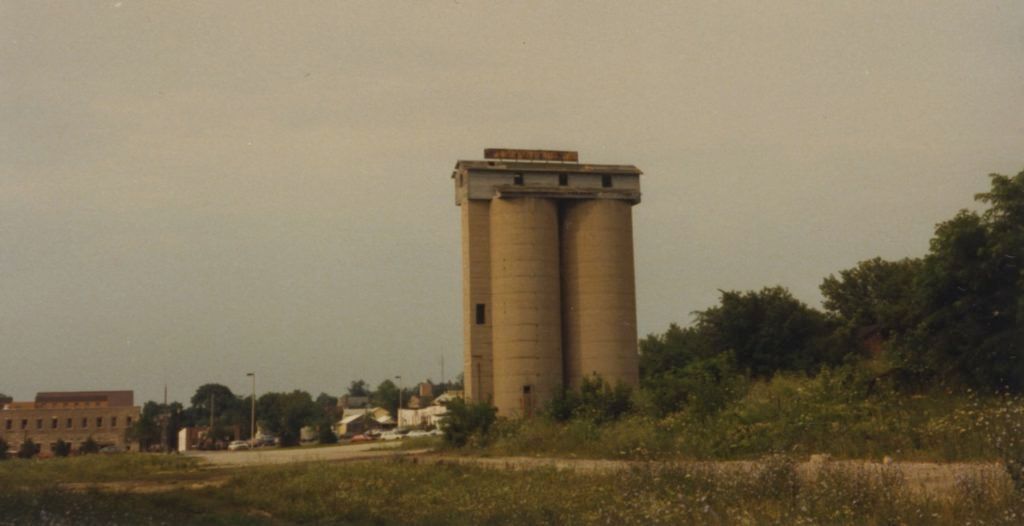
If you were in Geneva before 1995 you recognize this photograph of the former Joshel silos along North River Lane. They were built in 1917 by Mayer Joshel for his coal and feed business on Hamilton Street. The coal dropped from “Hopper Gondolas” into a pit. From there, the coal was taken by bucket conveyer to the top of the silos. Each silo was divided into four compartments and the coal was stored by grades and size. A shut-off handle could be opened to allow the coal to descend via a chute into trucks or wagons. A wooden structure sat on top of the silos – can you imagine the view from inside? The silos sat empty for decades and many people have stories of climbing them. I often dreamt about opening a restaurant at the top. Several options were considered to include the silos in the newly developed riverfront area, but nothing worked. The silos had major structural issues and a strong wind storm blew off pieces of the wooden structure causing hazardous conditions. The silos came tumbling down by a wrecking ball in May of 1995.